














Discover how Pilates can gently strengthen your core, improve spinal alignment, and ease chronic lower back pain through targeted, low impact movement.
Chronic lower back pain can make everyday movements, like getting out of bed, sitting at your desk, or picking up groceries, feel daunting.
While rest may seem like the safest option, research increasingly shows that gentle, targeted movement is one of the most effective long-term strategies for managing persistent back pain.
That’s where Pilates comes in.
Originally developed by Joseph Pilates, this method emphasizes controlled movement, deep core engagement, spinal alignment, and breathwork.
By strengthening the muscles that support your spine, especially the deep abdominals, glutes, and pelvic floor, Pilates can reduce strain on the lower back, improve posture, and build resilience against flare-ups.
Whether you practice on a mat at home, join a group class, work one-on-one with an instructor in a studio, or use equipment like a Reformer, Pilates offers adaptable tools that can meet you where you are.
Benefits of pilates, according to Dr. Gilbert:“Pilates teaches you how to articulate your spine and engage your deep core. Research has shown that Pilates can decrease low back pain compared to no exercise and non-specific exercise.”
— Dr. Courtney Gilbert, MD, Physical Medicine and Rehabilitation
The pelvic tilt is a foundational Pilates move that helps you find a neutral spine and gently mobilize the lower back.
Chronic lower back pain often involves limited mobility and a lack of awareness of pelvic positioning. The pelvic tilt improves coordination between your deep core muscles and your lumbar spine.
Learning to control your pelvis helps reduce unnecessary strain during daily movements such as standing, bending, and lifting.
You can practice pelvic tilts in a mat class, during a private studio session, or at home through a beginner-friendly video.
Because it’s low impact and highly adaptable, it’s often one of the first exercises introduced in both mat Pilates and equipment-based sessions.
How to do it
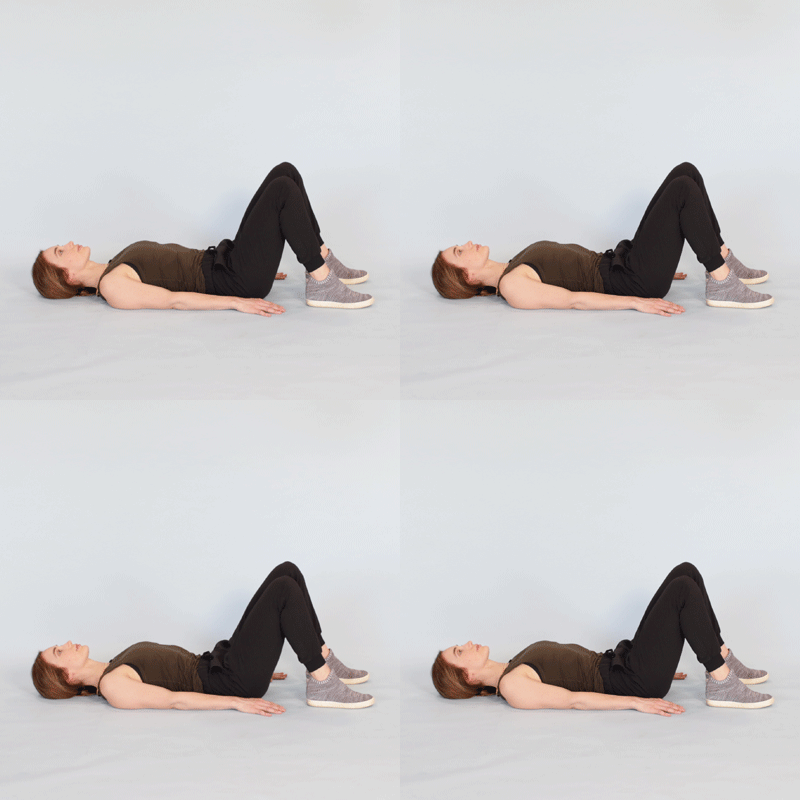
Lie on your back with your knees bent and feet hip-width apart on the floor. Let your arms rest by your sides. Inhale to prepare.
As you exhale, gently tilt your pelvis so your lower back presses into the mat, engaging your lower abdominals. Inhale to return to a neutral position, maintaining a small natural curve in your lower back.
Move slowly and with control for 8–12 repetitions.
Modification options
If lying flat is uncomfortable, place a small pillow under your head or perform the movement with your feet elevated on a chair.
If you’re in a studio, an instructor may guide this move on a Reformer with light spring tension for additional feedback and support.
Although commonly associated with physical therapy, the bird dog aligns well with Pilates principles of core stability and spinal control.
Bird dog strengthens the multifidus and transverses abdominis, which are deep muscles that stabilize the spine. Weakness or limited activation in these muscles is common in people with chronic lower back pain.
This exercise builds endurance and teaches your body to maintain spinal alignment during limb movement, which carries over to real-life tasks.
How to do it
Start on your hands and knees, with your wrists under your shoulders and your knees under your hips. Find a long, neutral spine. Inhale.
As you exhale, extend your right arm forward and your left leg back, keeping your hips level and your core gently engaged. Avoid arching your lower back. Inhale to return to center, then switch sides.
Perform 6–10 slow repetitions per side.
Modification options
If balancing on one hand and one knee feels unstable, begin by extending just one limb at a time. You can also keep your toes on the ground for added support.
In a studio setting, some instructors incorporate this pattern on equipment such as the Reformer to add resistance and provide alignment cues.
The glute bridge targets the hips and posterior chain, which play a critical role in unloading the lower back. When the glutes are weak, the lower back often compensates during activities like standing, walking, or climbing stairs.
Strengthening the glutes reduces that compensation and redistributes load more efficiently. The bridge also promotes hip extension, counteracting prolonged sitting, which is commonly a contributor to back discomfort.
Bridges are staples of both mat Pilates and reformer classes. They are easily incorporated into a home routine with minimal space or equipment.
How to do it
Lie on your back with knees bent and feet hip-width apart. Inhale to prepare. As you exhale, press through your heels and lift your hips off the mat, forming a straight line from shoulders to knees.
Engage your glutes without overarching your spine. Inhale at the top, then exhale to slowly lower down. Complete 8–12 repetitions.
Modification options
If lifting fully is uncomfortable, perform a smaller range of motion. You can also place a yoga block or a pillow between your knees to encourage inner-thigh engagement.
In equipment-based Pilates, bridges may be performed on the Reformer carriage, which provides resistance and feedback to ensure controlled movement.
Core strength isn’t just about the front of your body. The muscles along your sides, including the obliques and quadratus lumborum, help stabilize your spine.
The strengthens muscles that prevent side-to-side collapse, which is especially important during walking, carrying objects, or uneven movements. Building endurance here can decrease stress on the lumbar spine.
How to do it
Lie on your side with your elbow under your shoulder and knees bent. Stack your knees and lift your hips so your body forms a straight line from head to knees.
Keep your neck long and avoid collapsing into your shoulder. Hold for 10–20 seconds while breathing steadily, then lower with control. Repeat on the other side.
Modification options
If this position feels too challenging, keep your bottom hip lightly resting on the mat and focus on gently lifting and lowering your top hip. As you gain strength, you can extend your legs straight for a full side plank.
In a studio, props or equipment can be used to help you gradually build stability.
Mobility is just as important as strength. The spine stretch forward improves flexibility in the back body while reinforcing core control.
Moving gradually and within a pain-free range can ease stiffness without aggravating sensitive tissues.
How to do it
Sit tall with your legs extended hip-width apart. Flex your feet and sit on a folded towel if your hamstrings feel tight. Inhale to lengthen your spine.
As you exhale, gently nod your chin and round forward, reaching your arms toward your toes as if you’re draping over a large ball.
Keep your abdominals engaged and move slowly. Inhale to stack your spine back up one vertebra at a time. Perform 5–8 repetitions.
Modification options
If sitting upright is difficult, bend your knees slightly or sit against a wall for support. In reformer-based Pilates, a similar motion can be performed with assistance from the straps, which may help control range of motion.
Pilates comes in several formats, each with its own benefits.
- Mat Pilates: uses body weight and small props like resistance bands or balls, making it accessible at home or in group classes.
- Reformer Pilates: uses a spring-based machine that adds adjustable resistance and feedback, often found in dedicated studios.
If you’re managing chronic lower back pain, consider starting with a certified instructor who has experience working with injuries.
A private studio session allows for individualized assessment and tailored modifications. Small group classes can provide community and structure, while home videos offer convenience and affordability.
No matter the format, the key is controlled, intentional movement rather than pushing through pain.
Pilates can be an effective, low impact approach for managing chronic lower back pain because it blends core strengthening, spinal mobility, breath control, and mindful alignment.
By practicing foundational moves like pelvic tilts, bird dogs, glute bridges, modified side planks, and spine stretch forward, you can build the stability and flexibility your spine needs to feel supported in everyday life.
With patience and the right guidance, Pilates can help you move with greater comfort, confidence, and control.