Benlysta (belimumab) is a prescription medication used to treat active systemic lupus erythematosus (SLE) and active lupus nephritis. It can be given as an intravenous (IV) infusion or an injection under the skin.
Specifically, Benlysta is approved by the Food and Drug Administration (FDA) to treat active systemic lupus erythematosus (SLE) and active lupus nephritis in adults and children ages 5 years and older.
The following table shows recommended Benlysta dosages for treatment of active SLE in adults and children ages 5 years and older. Doses are in milligrams (mg) or milligrams per kilogram of body weight (mg/kg).
| Route of administration | Dosage for adults | Dosage for children |
|---|---|---|
| IV infusion | 10 mg/kg once every 2 weeks for three doses, then every 4 weeks | 10 mg/kg once every 2 weeks for three doses, then every 4 weeks |
| injection under the skin | 200 mg once per week | • Children who weigh at least 40 kg (88 lb): 200 mg once per week • Children who weigh at least 15 kg (33 lb) but less than 40 kg (88 lb): 200 mg once every 2 weeks |
The following table shows recommended Benlysta dosages for treatment of active lupus nephritis in adults and children ages 5 years and older. Doses are in milligrams (mg) or milligrams per kilogram of body weight (mg/kg).
| Route of administration | Dosage for adults | Dosage for children |
|---|---|---|
| IV infusion | 10 mg/kg once every 2 weeks for three doses, then once per month | 10 mg/kg once every 2 weeks for three doses, then once per month |
| injection under the skin | 400 mg once per week for four doses, then 200 mg once per week | • Children who weigh at least 40 kg (88 lb): 400 mg once per week for four doses, then 200 mg once per week • Children who weigh at least 15 kg (33 lb) but less than 40 kg (88 lb): 200 mg once per week for four doses, then 200 mg once every 2 weeks |
Note: The 400-mg doses of Benlysta injected under the skin require administration of two 200-mg injections.
The dosage of Benlysta you’re prescribed may depend on several factors. These include:
- the type and severity of the condition you’re using the drug to treat
- the form of Benlysta you’re using
- significant weight gain or weight loss
- other conditions you may have
Intravenous (IV) Infusion
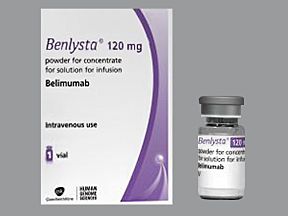
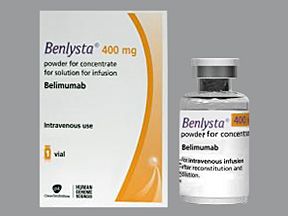
- Where: Administered by a healthcare professional in a clinic.
- Duration: Each infusion takes approximately 1 hour.
- Pre-medication: Your doctor may give you antihistamines or acetaminophen before the infusion to prevent infusion reactions.
Injection under the skin
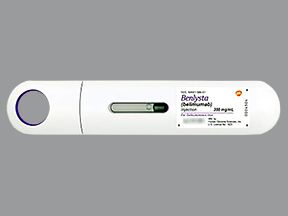
- Where: Self-administered at home via a prefilled autoinjector or syringe.
- Frequency: Typically once per week on the same day.
- Switching from IV infusions to injections under the skin: The first injection under the skin should be scheduled 1 to 4 weeks after the last IV infusion (1 to 2 weeks for lupus nephritis).
Yes, Benlysta is usually used as a long-term treatment. If you and your doctor determine that it’s safe and effective for your condition, you’ll likely use it long term.
If you’ve missed your appointment to receive Benlysta as an IV infusion, call your doctor’s office as soon as you remember to reschedule.
If you receive Benlysta as an injection under the skin and you miss a dose, you should give yourself the injection as soon as you remember. You can then resume your dosing schedule on the day of the week you usually receive Benlysta. Or if you prefer, you can start a new schedule using the day of the week you took the missed dose.
If you have questions about when you should give yourself your next injection after missing a dose, talk with your doctor or pharmacist.
Note: This summary article is for general educational purposes only. For more details, see Benlysta’s prescribing information or talk with your doctor or pharmacist. Also, always follow the specific Benlysta dosing instructions provided by your doctor.
Disclaimer: While Healthline strives for factual, comprehensive, and current information, this article is not a substitute for a licensed healthcare professional’s expertise. Always consult a doctor before taking or discontinuing any medication. Drug information is subject to change and may not cover all uses, directions, precautions, warnings, interactions, reactions, or adverse effects. The lack of a warning does not guarantee a drug’s safety, effectiveness, or appropriateness for all patients or specific uses. Learn more about our approach to content integrity.