Key takeaways
- Nucala (mepolizumab) is a prescription drug used to treat a certain kind of asthma, COPD, and some other immune-related conditions.
- The Nucala dosing frequency is typically on injection under the skin once every 4 weeks.
- Your dosage may vary based on your age and the type and severity of the condition you’re using the drug to treat.
Nucala is used to treat:
- chronic rhinosinusitis with nasal polyps in adults
- severe eosinophilic asthma in adults and some children
- chronic obstructive pulmonary disease (COPD) in adults
- eosinophilic granulomatosis with polyangiitis (Churg-Strauss syndrome) in adults
- hypereosinophilic syndrome in adults and some children
Do not use Nucala during a severe asthma attack. Use your rescue inhaler instead, as directed by your doctor.
The active ingredient in Nucala is mepolizumab. (An active ingredient is what makes a drug work.) Nucala is a biologic drug, which means it’s made from living cells.
This article describes the dosages of Nucala, its strengths, and how to use it.
The following table highlights the basics of Nucala’s dosage. The drug is given as an injection under your skin. All doses shown are in milligrams (mg).
| Condition | Recommended dose | Frequency |
|---|---|---|
| severe eosinophilic asthma (ages 12 years and older) | 100 mg | once every 4 weeks |
| severe eosinophilic asthma (ages 6 to 11 years) | 40 mg | once every 4 weeks |
| chronic rhinosinusitis with nasal polyps | 100 mg | once every 4 weeks |
| COPD | 100 mg | once every 4 weeks |
| eosinophilic granulomatosis with polyangiitis | three 100-mg injections (300 mg) | once every 4 weeks |
| hypereosinophilic syndrome | three 100-mg injections (300 mg) | once every 4 weeks |
Keep reading for more details about Nucala’s dosage.
Nucala patient information PDF
For more Nucala patient information, you can view this PDF of the drug’s prescribing information, including step-by-step instructions for how to administer your injections.
Nucala forms
Nucala comes in three injectable forms that are given under the skin:
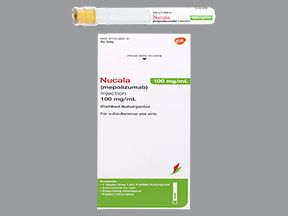
- liquid solution inside a prefilled auto-injector
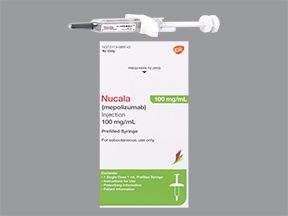
- liquid solution inside a prefilled syringe
- powder inside a vial, which is mixed with liquid to make a solution for use in a syringe
Nucala strengths
Nucala is available in the following strengths:
- 40 mg per 0.4 milliliter of solution (mL) in a single-dose prefilled syringe
- 100 mg per mL in a prefilled auto-injector or single-dose syringe
- 100 mg of powder in a single-dose vial that’s mixed with liquid to make a solution for use in a syringe
Nucala is approved to treat the following conditions:
- chronic rhinosinusitis with nasal polyps that weren’t effectively treated with nasal corticosteroids
- severe eosinophilic asthma
- eosinophilic granulomatosis with polyangiitis (Churg-Strauss syndrome)
- hypereosinophilic syndrome
The prescribed Nucala dosage may vary depending on the condition it’s used to treat. Always follow your doctor’s instructions. Notify them if you experience any Nucala side effects that may prevent you from taking your medication.
Dosing for severe asthma
The Nucala dosage for treating severe eosinophilic asthma in adults is one 100-mg injection every 4 weeks.
Dosing for nasal polyps
Nucala’s dosage for chronic rhinosinusitis with nasal polyps in adults is one 100-mg injection every 4 weeks.
Dosing for COPD
Nucala’s dosage for COPD in adults is one 100-mg injection every 4 weeks.
Dosing for eosinophilic granulomatosis with polyangiitis
The dosage for eosinophilic granulomatosis with polyangiitis in adults is 300 mg. This is given as three 100-mg injections every 4 weeks.
Dosing for hypereosinophilic syndrome
The Nucala dosage for treating hypereosinophilic syndrome in adults is 300 mg. It’s given as three 100-mg injections every 4 weeks.
If you have questions about your dosage of Nucala, talk with your doctor to learn more.
Nucala is approved to treat severe eosinophilic asthma in children ages 6 years and older.
The dosage of Nucala for severe eosinophilic asthma in children ages 12 years and older is the same as for adults. 100 mg is given as an injection under the skin once every 4 weeks.
The dosage for severe eosinophilic asthma in children ages 6 to 11 years is 40 mg given as an injection under the skin once every 4 weeks.
Nucala is also approved to treat hypereosinophilic syndrome in children ages 12 years and older. The dosage is 300 mg given as three separate 100-mg injections under the skin once every 4 weeks.
The dosage of Nucala you’re prescribed may depend on several factors. These include your age and the type and severity of the condition you’re using the drug to treat.
Nucala is available in three dosage forms, all of which are given as an injection under the skin:
- liquid solution in a prefilled auto-injector
- liquid solution in a prefilled syringe
- powder in a single dose vial that’s mixed with liquid to make a solution for use in a syringe
You may get Nucala injections at your doctor’s office or a clinic. Your doctor may also train you or a caregiver on how to inject Nucala at home with the prefilled syringe or auto-injector. (Only a healthcare professional can administer the powder dosage form of Nucala.)
If you have questions about how to inject your dose of Nucala, ask your pharmacist. They can answer your questions and show you how to give yourself your dose.
Medical Perspective“Pinch the skin: For subcutaneous injections, gently pinching a fold of skin can help ensure proper depth and reduce discomfort.”
For more information on subcutaneous injection, visit this article.
Quotes represent the opinions of our medical experts. All content is strictly informational and should not be considered medical advice.
How long should I take Nucala?
Nucala is usually a long-term treatment. If you and your doctor determine that it’s safe and effective for your condition, you’ll likely use it long term.
If you miss giving yourself your regularly scheduled dose of Nucala, inject the dose as soon as you remember. But if it’s too close to your next regular dose, skip the missed dose. Do not give yourself two injections of Nucala at one time. This could increase your risk of side effects from Nucala.
If you receive Nucala at your doctor’s office and miss an appointment, call their office to reschedule your injection.
If you need help remembering your Nucala injections, try using a medication reminder. This can include setting an alarm or downloading a reminder app on your phone.
Do not use more Nucala than your doctor prescribes, as this can lead to serious side effects.
What to do in case you inject too much Nucala
Call your doctor right away if you think you’ve injected too much Nucala. You can also call 800-222-1222 to reach America’s Poison Centers or use its online resource. But if you have severe symptoms, immediately call 911 (or your local emergency number) or go to the nearest emergency room.
Nucala is prescribed to treat asthma, COPD, and other immune-related conditions. Remember, you should not change your dosage of Nucala without your doctor’s recommendation. Only use Nucala exactly as prescribed. Talk with your doctor if you have questions or concerns about your current dosage.
Disclaimer: While Healthline strives for factual, comprehensive, and current information, this article is not a substitute for a licensed healthcare professional’s expertise. Always consult a doctor before taking or discontinuing any medication. Drug information is subject to change and may not cover all uses, directions, precautions, warnings, interactions, reactions, or adverse effects. The lack of a warning does not guarantee a drug’s safety, effectiveness, or appropriateness for all patients or specific uses. Learn more about our approach to content integrity.