Key takeaways
- The dosage of Repatha may vary based on the condition it’s being used to treat.
- Your dosage of Repatha could be 140 milligrams (mg) or 420 mg every 2 weeks, or you might use 420 mg monthly.
- Repatha comes as a liquid solution that you inject under your skin using either a prefilled syringe or a SureClick Autoinjector. It’s important to rotate injection sites with each dose.
Repatha (evolocumab) is a prescription drug used to lower cholesterol and decrease serious heart-related risks. The drug comes as a liquid solution that you inject under your skin. It’s usually given every 2 weeks or monthly.
Specifically, Repatha is used to:
- decrease low-density lipoprotein (LDL) cholesterol (together with a cholesterol-lowering diet and sometimes other cholesterol-lowering drugs) in:
- adults with high cholesterol
- adults and some children with homozygous familial hypercholesterolemia (HoFH) or heterozygous familial hypercholesterolemia (HeFH)
- reduce the risk of stroke, heart attack, and the need for surgery to improve blood flow to the heart, in adults with heart disease
The active ingredient in Repatha is evolocumab. (An active ingredient is what makes a medication work.)
Repatha is a biologic medication, which means it’s made from living cells. It belongs to a group of drugs called PCSK9 inhibitors, which help lower LDL cholesterol.
This article describes the dosages of Repatha, as well as its strengths and how to administer it. To learn more about this drug, including its side effects and uses, read this in-depth Repatha article.
Your doctor will likely start you on a low dosage of Repatha and adjust it over time to reach the right amount for you. They’ll ultimately prescribe the smallest dosage that provides the desired effect.
The following table highlights the basics of Repatha’s dosages.
Always inject the dosage your doctor prescribes for you. They’ll determine the best dosage to fit your needs. In some cases, doctors may adjust your dosage from those shown here.
| Purpose | Dosage |
|---|---|
| reducing LDL cholesterol in adults with high cholesterol | 140 mg once every 2 weeks or 420 mg once every month |
| reducing LDL cholesterol in adults with HoFH | 420 mg once every month |
| reducing LDL cholesterol in children ages 10 years and older with HeFH | 140 mg once every 2 weeks or 420 mg once every month |
| reducing LDL cholesterol in children ages 10 years and older with HoFH | 420 mg once every month |
| reducing the risk of heart attack, stroke, and the need for certain heart surgeries in adults with cardiovascular disease | 140 mg once every 2 weeks, or 420 mg once every month |
Repatha form
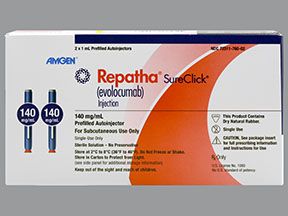
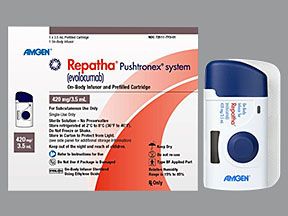
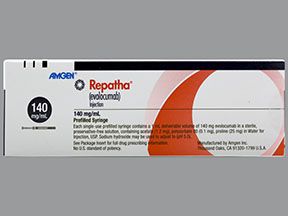
Repatha comes as a liquid solution that you inject under your skin. It’s available in two delivery options: prefilled syringes and SureClick Autoinjectors.
Repatha strengths
Repatha comes in two strengths: 140 mg/mL and 420 mg/3.5 mL
The prescribed Repatha dosage may vary depending on the condition it’s being used to treat. Always follow your doctor’s instructions. Notify them if you experience any side effects that may prevent you from administering your medication.
Dosage for heart disease or high cholesterol, including inherited HeFH
Repatha is used to reduce the risk of stroke, heart attack, and the need for surgery to improve blood flow to the heart in adults with heart disease.
It’s prescribed together with a cholesterol-lowering diet and sometimes other cholesterol-lowering drugs to reduce LDL cholesterol. For this use, it’s prescribed for adults with high cholesterol, as well as adults and some children with HeFH.
For these uses, the typical dosage of Repatha is either:
- a 140-mg injection every 2 weeks
- a 420-mg injection every month
Dosage for inherited HoFH
Repatha is prescribed, along with a cholesterol-lowering diet and other cholesterol-lowering drugs, to decrease LDL cholesterol in adults with HoFH.
For this use, the starting dosage is usually a 420-mg injection under your skin once each month. If the drug isn’t working well enough after 12 weeks, your doctor may increase your dosage to 420 mg every 2 weeks.
If you’re also receiving LDL apheresis (a process to remove LDL cholesterol from your blood), you’ll likely start Repatha after that treatment session ends. In this case, your starting dose may be a 420-mg injection every 2 weeks.
Repatha is only prescribed for children ages 10 years and older.
Dosage for children with HeFH
The usual dosage of Repatha for HeFH in children ages 10 years and older is:
- a 140-mg injection every 2 weeks
- a 420-mg injection every month
Dosage for children with HoFH
The usual dosage of Repatha for HoFH in children ages 10 years and older is a 420-mg injection once each month.
Dosage increases and the dosage for those receiving LDL apheresis are similar to those for adults. (See the “Repatha dosages by condition” section.)
Repatha comes as a liquid solution that you inject under your skin using either a prefilled syringe or a SureClick Autoinjector. You can ask your doctor or pharmacist for a demonstration of how to inject the drug correctly with these devices.
General guidelines apply when you inject Repatha:
- Store the drug container in the refrigerator in its original packaging.
- Do not use the same injection site for two scheduled doses in a row. (Injection sites include the thigh, upper arm, and abdomen.)
- Avoid injecting into skin that is discolored, broken, hard, tender, or has stretch marks.
- Clean and dry the injection site before injecting Repatha.
- Throw away any used medication in a hard plastic container for sharp objects.
For more information about how to use Repatha, including a video about the use of the SureClick Autoinjector, see the manufacturer’s website.
Accessible drug containers and labels
If you find it hard to read the prescription label on your medication, tell your doctor or pharmacist. Some pharmacies provide medication labels that:
- have large print or use braille
- feature a code you can scan with a smartphone to change the text to audio
Your doctor or pharmacist may be able to recommend pharmacies that offer these accessibility features if your current pharmacy doesn’t.
The instructions for injecting a missed Repatha dose depend on your dosage schedule.
For doses given every 2 weeks: If it’s still within 7 days of your missed dose, give yourself the injection and resume your dosing schedule. If it’s more than 7 days after your missed dose, wait until your next scheduled dose and resume your dosing schedule.
For doses given once every month: Give yourself the Repatha injection on the day you realize you missed the dose. Use the day you gave the injection as the start day of a new dosing schedule.
If you need help remembering to inject your dose of Repatha on time, try using a medication reminder. This can include setting an alarm or downloading a reminder app on your phone. You can also mark your dosing schedule on a paper calendar if that works better for you.
Call your doctor right away if you think you’ve injected too much Repatha. You can also call 800-222-1222 to reach America’s Poison Centers or use its online resource. But if you have severe symptoms, immediately call 911 (or your local emergency number) or go to the nearest emergency room.
The following are answers to some commonly asked questions about Repatha’s dosage.
What is the best time of day to inject Repatha?
Repatha can be given at any time of day, but it’s best to inject it around the same time each day a dose is given. This helps keep a steady level of the drug in your body, which helps Repatha work effectively.
Talk with your doctor or pharmacist if you have questions about when to inject Repatha.
Can I inject my Repatha dose using the prefilled syringe if I’m allergic to latex?
It depends on how severe your latex allergy is. The needle cover on the Repatha prefilled syringe and the SureClick Autoinjector contains a latex-like material that may cause an allergic reaction. If you’re allergic to latex, talk with your doctor about how to safely use Repatha.
Is Repatha used long term?
Yes, Repatha is usually prescribed as a long-term treatment. How long you use Repatha will depend on how well the drug works for your condition. If you and your doctor determine it’s safe and effective for your condition, you’ll likely use it long term.
Disclaimer: Healthline has made every effort to make certain that all information is factually correct, comprehensive, and up to date. However, this article should not be used as a substitute for the knowledge and expertise of a licensed healthcare professional. You should always consult your doctor or another healthcare professional before taking any medication. The drug information contained herein is subject to change and is not intended to cover all possible uses, directions, precautions, warnings, drug interactions, allergic reactions, or adverse effects. The absence of warnings or other information for a given drug does not indicate that the drug or drug combination is safe, effective, or appropriate for all patients or all specific uses.